

Hi there, tudo certinho por aí?
Quem me acompanha sabe que eu adoro mergulhar nas curiosidades e, claro, trazer tudo isso para vocês de um jeito que a gente aprende inglês na prática, sem complicação. E hoje, a gente vai fazer uma viagem no tempo e na arte que é simplesmente sensacional!
Sabe aquele ditado uma imagem vale mais que mil palavras? Pois é, com a pintura que a gente vai desvendar hoje, esse ditado faz todo o sentido! Preparem-se para conhecer a fundo a história por trás de um dos retratos mais famosos da realeza, pintado por ninguém menos que Francisco de Goya.
A gente vai analisar cada detalhe, cada personagem, e descobrir uns segredos de família que, olha… nem novela das nove! E o melhor: tudo isso com o nosso método, onde você tem o texto original em inglês, a tradução pra não perder nada e o áudio nativo pra treinar seu listening e pronunciation.
Então, se você tá pronto pra desvendar mistérios, aprender vocabulário novo e ainda se divertir, vem comigo que a aula de hoje tá imperdível! Bora lá? Let’s do this!
TEXTO TRADUZIDO
In the spring of 1800, Spanish court painter Francisco de Goya received a commission from King Carlos IV, a direct ancestor of King Juan Carlos, to create a portrait of the royal family. At the time, the family was staying at their summer residence in Aranjuez, near Madrid.
(Na primavera de 1800, o pintor da corte espanhola Francisco de Goya recebeu uma encomenda do rei Carlos IV, ancestral direto do rei Juan Carlos, para pintar um retrato da família real. Na época, a família estava hospedada em sua residência de verão em Aranjuez, perto de Madri.)
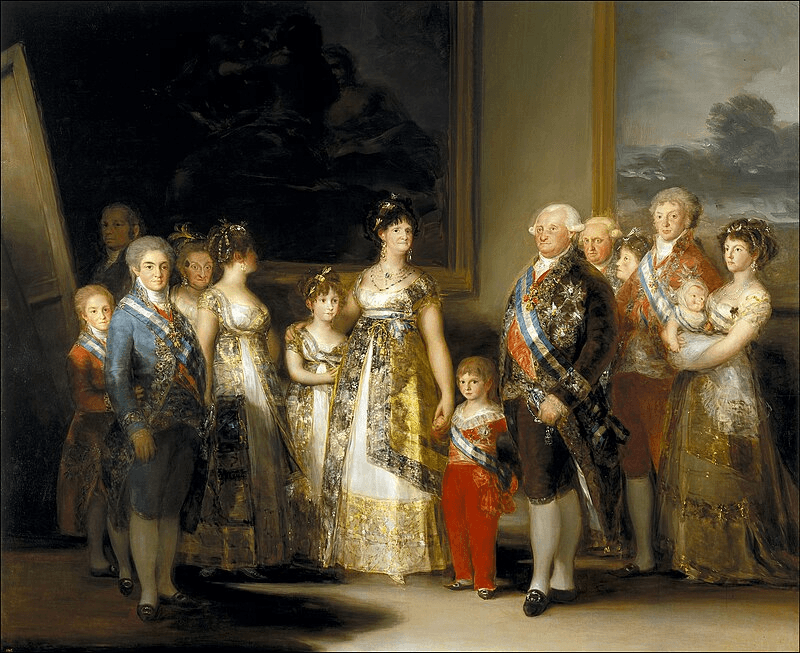
On the far left of the painting stands Prince Carlos, the King’s second son. Beside him is his elder brother, Prince Fernando, the heir to the throne. Fernando, who harbored deep resentment toward his parents—especially his mother—ended up inheriting many of her traits. Like her, he was vain and authoritarian. When he eventually ascended to the throne, he became highly unpopular.
(No extremo esquerdo da pintura está o príncipe Carlos, o segundo filho do rei. Ao lado dele está seu irmão mais velho, o príncipe Fernando, herdeiro do trono. Fernando, que nutria um profundo ressentimento pelos pais — especialmente pela mãe — acabou herdando muitos dos traços dela. Como ela, ele era vaidoso e autoritário. Quando finalmente subiu ao trono, tornou-se extremamente impopular.)
Behind Fernando stands an older woman, Maria Josefa, the King’s sister. She never married or had children and passed away shortly after the painting was completed.
(Ao fundo de Fernando está uma mulher mais velha, Maria Josefa, irmã do rei. Ela nunca se casou nem teve filhos, e faleceu pouco tempo depois que a pintura foi concluída.)
Next to her is a young woman whose face is turned away, making her identity uncertain. She is known as the “mystery figure” of the portrait.
(Ao lado dela está uma jovem cujo rosto está voltado para o lado, o que torna sua identidade incerta. Ela é conhecida como a “figura misteriosa” da pintura.)
There are two main theories regarding who she might be. One suggests she is Princess Maria Amalia, one of the King’s daughters who had died in childbirth three years earlier. Her turned-away face would symbolize her death. The more accepted theory, however, is that she represents Fernando’s future wife—someone he hadn’t met yet. Including her in the painting would have symbolized the hope that he would eventually marry and continue the royal line. Interestingly, Fernando married four times during his life.
(Há duas teorias principais sobre quem ela poderia ser. Uma sugere que seja a princesa Maria Amalia, uma das filhas do rei que havia morrido no parto três anos antes da pintura. O fato de estar de costas representaria sua morte. No entanto, a teoria mais aceita é que ela represente a futura esposa de Fernando — alguém que ele ainda não conhecia. Incluir essa figura na pintura simbolizaria a esperança de que ele se casaria um dia e daria continuidade à linhagem real. Curiosamente, Fernando se casou quatro vezes ao longo da vida.)
Next to the unidentified woman is Princess Maria Isabel, the youngest of the King’s daughters. She eventually married and became the mother of twelve children.
(Ao lado da mulher não identificada está a princesa Maria Isabel, a filha mais nova do rei. Ela acabou se casando e teve doze filhos.)
The central figure in the painting is Queen Maria Luisa. Goya placed her at the center to reflect her strong will and dominating role over her husband, the King. In her youth, she was renowned for her beauty. Although her looks had faded by the time of the painting, she remained extremely vain, compensating with luxurious clothing and jewels.
(A figura central da pintura é a rainha Maria Luísa. Goya a colocou no centro para refletir sua personalidade forte e seu papel dominante sobre o marido, o rei. Na juventude, ela era conhecida por sua beleza. Embora sua aparência já tivesse mudado na época da pintura, ela continuava muito vaidosa, compensando com roupas luxuosas e joias.)
The little boy near the Queen is her youngest son, Prince Francisco. Sensitive by nature, he suffered throughout his life due to his striking resemblance to one of his mother’s rumored lovers, leading many to believe he was not the King’s biological son.
(O menino pequeno próximo da rainha é seu filho mais novo, o príncipe Francisco. Sensível por natureza, ele sofreu a vida toda por causa de sua semelhança impressionante com um dos supostos amantes da mãe, o que levou muitos a acreditarem que ele não era filho biológico do rei.)
Next to Francisco stands King Carlos IV. Despite beginning his reign with big ideas and aspirations, he was a weak ruler, constantly overshadowed by his wife and advisors. He ultimately died disheartened and dissatisfied.
(Ao lado de Francisco está o rei Carlos IV. Apesar de ter começado seu reinado com grandes ideias e aspirações, ele era um governante fraco, constantemente ofuscado pela esposa e pelos conselheiros. Acabou morrendo desiludido e insatisfeito.)
Behind him is his brother, and just to the right, though only partially visible, is his eldest daughter, Carlota. Her parents arranged her marriage while she was still very young. Ambitious and politically astute, Carlota eventually became Queen of Portugal.
(Atrás dele está seu irmão e, logo à direita, embora apenas parcialmente visível, está sua filha mais velha, Carlota. Seus pais arranjaram seu casamento quando ela ainda era muito jovem. Ambiciosa e politicamente astuta, Carlota acabou se tornando rainha de Portugal.)
The final trio in the painting consists of the Queen’s brother, Don Luis de Parma, his wife Maria Luisa, and their infant son. Interestingly, Maria Luisa was both his wife and his niece, being the King’s second daughter. Initially, Don Luis was meant to wed Carlota, the eldest daughter, but he fell in love with Maria Luisa instead. Intelligent and spirited, she won his heart, and he insisted on marrying her.
(O trio final da pintura é composto pelo irmão da rainha, Dom Luís de Parma, sua esposa Maria Luisa e o filho bebê do casal. Curiosamente, Maria Luisa era ao mesmo tempo sua esposa e sua sobrinha, sendo a segunda filha do rei. Inicialmente, Dom Luís deveria se casar com Carlota, a filha mais velha, mas acabou se apaixonando por Maria Luisa. Inteligente e cheia de vida, ela conquistou seu coração, e ele insistiu em se casar com ela.)
Rather than gathering the whole family together for one sitting, which would have taken too long, Goya created individual sketches of each person and later combined them into the final composition. The entire work took him two years to finish and ended up being the last official royal portrait he ever painted.
(Em vez de reunir toda a família para posar ao mesmo tempo — o que teria demorado demais — Goya fez esboços individuais de cada pessoa e depois os combinou na composição final. A obra toda levou dois anos para ser concluída e acabou sendo o último retrato oficial da família real que ele pintou.)
Notably, Goya included himself in the background of the painting, positioned to the left behind the two princes. King Carlos IV referred to the portrait as “the family all together picture,” and it was originally displayed in Madrid’s Royal Palace.
(Curiosamente, Goya incluiu a si mesmo no fundo da pintura, posicionado à esquerda atrás dos dois príncipes. O rei Carlos IV se referia ao retrato como “a imagem da família toda reunida”, e ele foi originalmente exibido no Palácio Real de Madri.)
Veja também:
⇒ Texto avançado C2: NO PLACE TO PARK (áudio e tradução)
⇒ THE 4TH OF JULY | Dia da Independência dos EUA (texto com tradução e áudio)
⇒ TEXTO INTERMEDIÁRIO com Áudio: In the Beginning…(com áudio)