


Hi there, tudo certinho por aí?
Chegou a hora de conferir a versão corrigida da prova de inglês da Unesp 2026! Mais do que simplesmente descobrir quais eram as respostas certas, esta é uma ótima oportunidade para entender a lógica das questões, revisar vocabulário, treinar a interpretação de textos e identificar os pontos que mais costumam aparecer no vestibular.
Então, pegue sua prova, compare suas respostas e aproveite cada comentário para transformar os erros em aprendizado. Afinal, cada questão analisada é mais um passo rumo à aprovação.
Are you ready? Let’s do this!
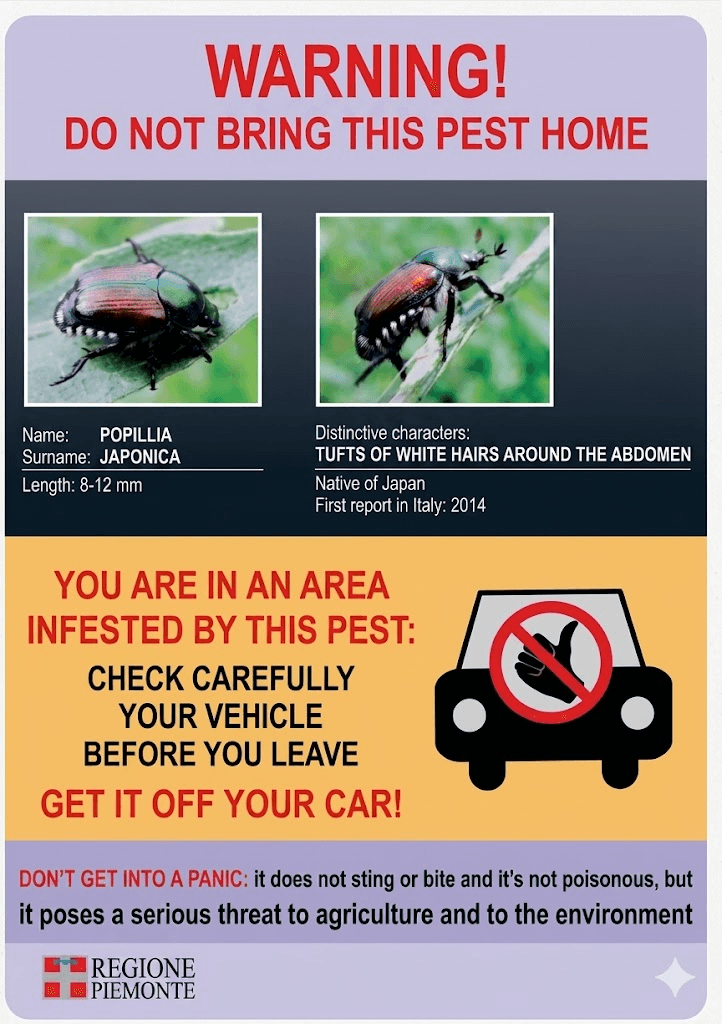
Examine o cartaz para responder às questões 21 e 22.
QUESTÃO 21.
The main purpose of the poster is to
A – point out that the pest is out of control.
B – prevent people from being scared.
C – warn that the insect bite might hurt.
D – inform people that driving is prohibited in the area.
E – avoid risks for crops and the environment.
Resposta: E.
QUESTÃO 22.
In the excerpt from the poster “Do not bring this pest home”, the word in bold refers to
A – Regione Piemonte, Italy.
B – Japan.
C – the surroundings of the poster.
D – the vehicle itself.
E – the final destination of the car traveler.
Resposta: E
Leia o texto para responder às questões de 23 a 28. [Acompanhe também com o áudio.]
Dr. Mariangela Hungria will receive the $500,000 award for her work to utilize biological processes to sustainably improve crop nutrition, yields and productivity.
The scientist whose discoveries helped Brazil become a global agricultural powerhouse has been named the 2025 World Food Prize Laureate.
Dr. Mariangela Hungria, a microbiologist from São Paulo, has developed dozens of biological seed and soil treatments that help crops source nutrients through soil bacteria, significantly increasing yields of major crops while also reducing the need for synthetic fertilizer.
Her products are estimated to have been used across more than 40 million hectares in Brazil, saving farmers up to US$40 billion a year in costs while avoiding more than 180 million metric tons of CO2 equivalent emissions per year.
Dr. Hungria’s work has helped improve yields of wheat, corn, rice, common beans, and other major crops, including soybean, which is now Brazil’s top agricultural export.
Over her 40-year career with the Brazilian Agricultural Research Corporation (Embrapa), national soybean production increased from 15 million tons in 1979 to an anticipated 173 million tons in the next harvest in 2025.
Dr. Hungria, who overcame prejudices against women and young mothers in academia to be named one of the 100 most powerful women in agriculture in Brazil by Forbes magazine in 2021, said she was inspired by Dr. Norman Borlaug, the father of the Green Revolution and founder of the World Food Prize.
“I like to say that he made the Green Revolution possible, and we had this great opportunity to start a ‘micro green revolution’ — a green revolution, but with microorganisms,” she added. “I can’t quite believe I am now receiving the World Food Prize.
Many people questioned me and my abilities throughout my career but I believed in what I was doing and persevered.
The role of women in agriculture, from farming to science, deserves more recognition. I hope my achievement inspires others to pursue their passions in science.”
(www.worldfoodprize.org, 13.05.2025. Adaptado.)
crop: cultivated plant that is grown as food, especially grain, fruit or vegetable.
yields: the full amounts of an agricultural product.
harvest: the crops that are cut and collected.
QUESTÃO 23.
According to the text, Dr. Hungria’s research showed positive results in
A – Green Revolution petrochemical development.
B – agricultural production improvement.
C – genetically modified soybean seeds.
D – effective synthetic fertilizers.
E – elimination of soil bacteria.
Resposta: B.
QUESTÃO 24.
No trecho do segundo parágrafo “saving farmers up to US$40 billion a year in costs while avoiding more than 180 million metric tons of CO2 equivalent emissions per year”, o termo em negrito indica
A – sequência.
B – contraste.
C – simultaneidade.
D – causa.
E – alternância.
Resposta: C.
QUESTÃO 25.
De acordo com o texto, a cultura agrícola que foi mais impactada pela pesquisa da Dra. Mariangela Hungria é a
A – do milho.
B – do feijão.
C – do arroz.
D – da soja.
E – do trigo.
Resposta: D.
QUESTÃO 26.
According to the fourth paragraph, Dr. Hungria partly attributes her success to
A – prejudice.
B – fame.
C – recognition.
D – perseverance.
E – religion.
Resposta: D.
QUESTÃO 27
In the excerpt from the fourth paragraph “this great opportunity to start a ‘micro green revolution’ — a green revolution, but with microorganisms”, the phrase in bold
A – explains a concept.
B – provides an example.
C – adds a needless remark.
D – presents a consequence.
E – highlights a contrast.
Resposta: A.
QUESTÃO 28.
According to the fourth paragraph, during her career, Dr. Hungria had to face
A – excessive supervision by Dr. Norman Borlaug.
B – problems with young mothers in her team.
C – strange questions posed by her friends.
D – pressure to please Forbes magazine editors.
E – gender bias against women in science.
Resposta: E.
Tradução do texto:
A Dra. Mariangela Hungria receberá o prêmio de US$ 500 mil por seu trabalho na utilização de processos biológicos para melhorar de forma sustentável a nutrição, os rendimentos e a produtividade das lavouras.
A cientista cujas descobertas ajudaram o Brasil a se tornar uma potência agrícola global foi nomeada a vencedora do Prêmio Mundial da Alimentação (World Food Prize) de 2025.
A Dra. Mariangela Hungria, microbiologista de São Paulo, desenvolveu dezenas de tratamentos biológicos para sementes e solos que ajudam as plantas a obter nutrientes por meio de bactérias presentes no solo, aumentando significativamente a produtividade das principais culturas agrícolas e, ao mesmo tempo, reduzindo a necessidade de fertilizantes sintéticos.
Estima-se que seus produtos tenham sido utilizados em mais de 40 milhões de hectares no Brasil, proporcionando aos agricultores uma economia de até US$ 40 bilhões por ano em custos e evitando a emissão de mais de 180 milhões de toneladas métricas de CO₂ equivalente por ano.
O trabalho da Dra. Hungria ajudou a aumentar a produtividade do trigo, do milho, do arroz, do feijão e de outras importantes culturas agrícolas, incluindo a soja, que hoje é o principal produto de exportação agrícola do Brasil.
Ao longo de seus 40 anos de carreira na Empresa Brasileira de Pesquisa Agropecuária (Embrapa), a produção nacional de soja aumentou de 15 milhões de toneladas em 1979 para uma previsão de 173 milhões de toneladas na próxima safra, em 2025.
A Dra. Hungria, que superou preconceitos contra mulheres e jovens mães no meio acadêmico para ser nomeada uma das 100 mulheres mais poderosas da agricultura no Brasil pela revista Forbes em 2021, afirmou que foi inspirada pelo Dr. Norman Borlaug, considerado o pai da Revolução Verde e fundador do Prêmio Mundial da Alimentação.
“Gosto de dizer que ele tornou possível a Revolução Verde, e nós tivemos esta grande oportunidade de iniciar uma ‘micro revolução verde’ — uma revolução verde, mas com microrganismos”, acrescentou. “Ainda não consigo acreditar que estou recebendo agora o Prêmio Mundial da Alimentação.
Muitas pessoas questionaram a mim e às minhas capacidades ao longo da minha carreira, mas eu acreditava no que estava fazendo e perseverei.
O papel das mulheres na agricultura, desde o trabalho no campo até a ciência, merece mais reconhecimento. Espero que minha conquista inspire outras pessoas a seguirem suas paixões pela ciência.”
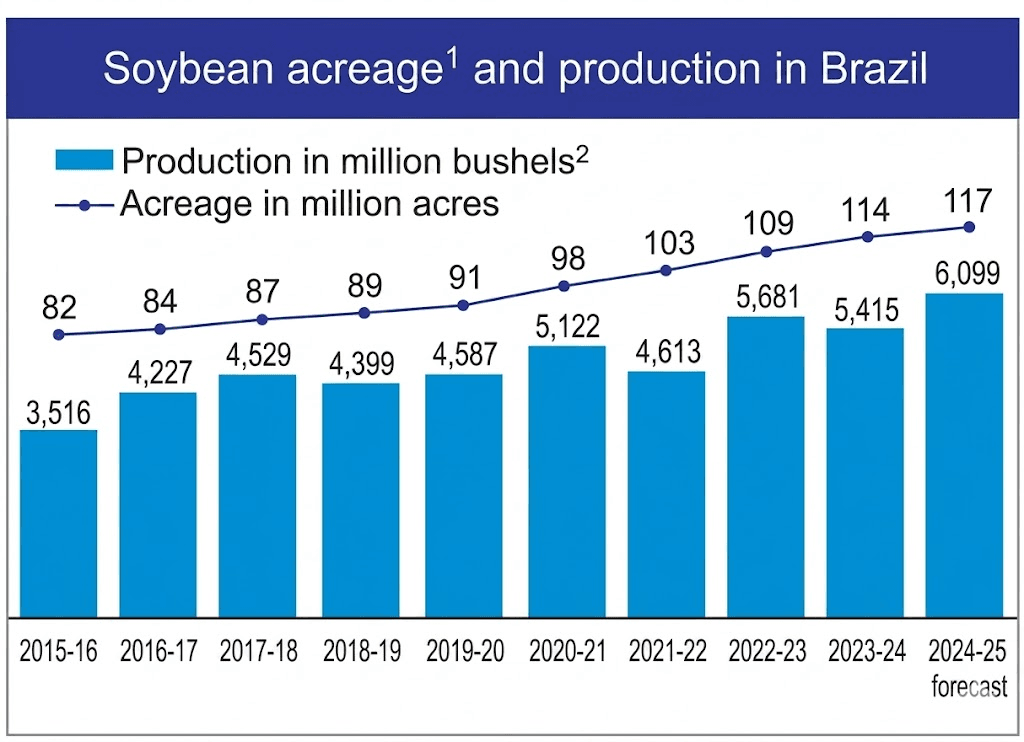
(www.farmprogress.com, 25.03.2025. Adaptado.)
acreage: an area of land measured in acres.
bushel: a measure internationally used for grains; for soybean, it is equivalent to 27,216 kg.
QUESTÃO 29.
According to the information presented in the chart,
A – the 2016-17 production fell, despite an increase in planted area.
B – the planted area is proportional to the soybean production in all the periods of time.
C – the increase in planted area not necessarily results in a greater production.
D – the planted area has been increasing at a constant acreage from 2015 to 2025.
E – from 2020 onwards, there has been a steady decrease in soybean production.
Resposta: C.
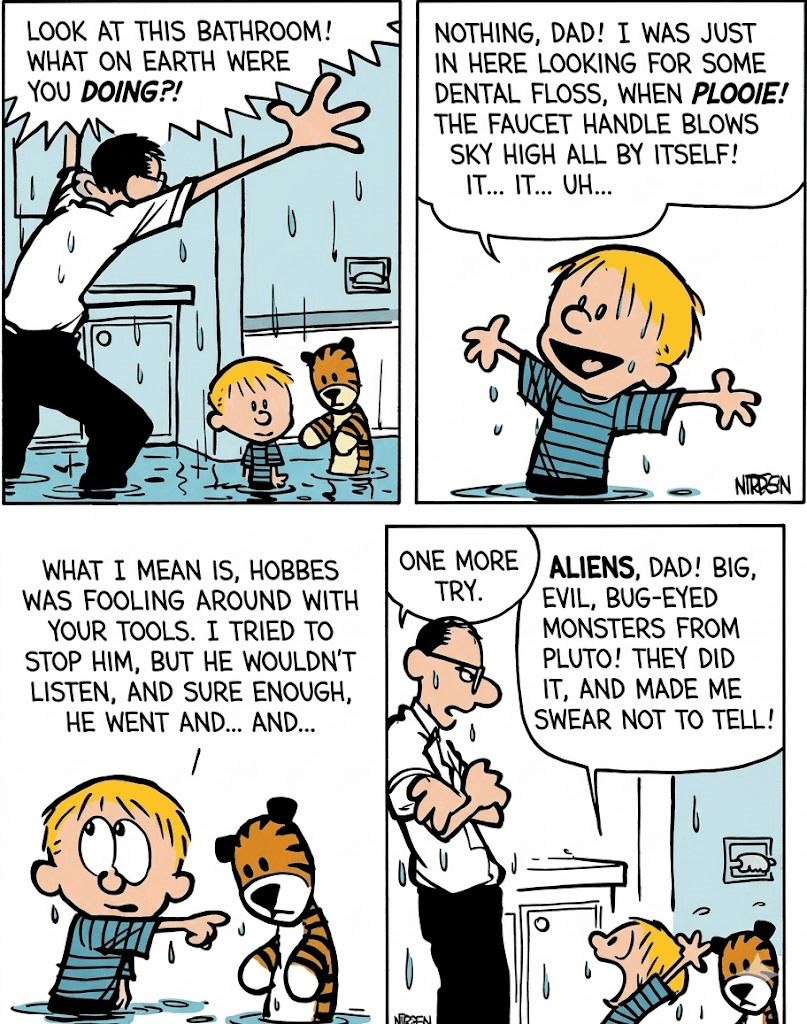
Examine a tira de Bill Watterson.
QUESTÃO 30.
In the comic strip, Calvin, the boy,
A – tried to make up excuses for what he had done wrong.
B – believed there were aliens that wanted to snatch him and the tiger.
C – assured the tiger helped him break the faucet with his father’s tools.
D – convinced his father that the faucet suddenly broke by itself.
E – was pleased because his father did not believe his explanations.
Resposta: A.
Veja também:
⇒ ENEM 2025 – Prova de Inglês Corrigida (Azul) – com tradução e áudio
⇒ ENEM 2024 – Prova de Inglês Corrigida
⇒ ENEM 2023 | Prova de Inglês Corrigida e Comentada
⇒ ENEM 2022 – Prova de Inglês Corrigida e Comentada